

Every year after JEE Main, the biggest question that comes into every student’s mind is simple:
👉 “Is baar kitne marks pe qualify hoga?”
With JEE Main 2026 result around the corner, students are eagerly searching for expected passing marks, cutoff trends, and safe scores for admission into NITs, IIITs, GFTIs, and JEE Advanced qualification.
But the truth is—JEE Main cutoff is not fixed. It changes every year depending on difficulty level, number of students, and overall performance.
Let’s understand it in a simple and clear way.
📊 What Are Passing Marks in JEE Main 2026?
The National Testing Agency (NTA) does not officially declare a fixed “passing mark out of 300” for JEE Main.
Instead, what matters is:
- Percentile score
- Category-wise cutoff
- JEE Advanced qualifying cutoff
👉 So, “passing marks” actually means the minimum percentile required to qualify for the next stage, not just raw marks.
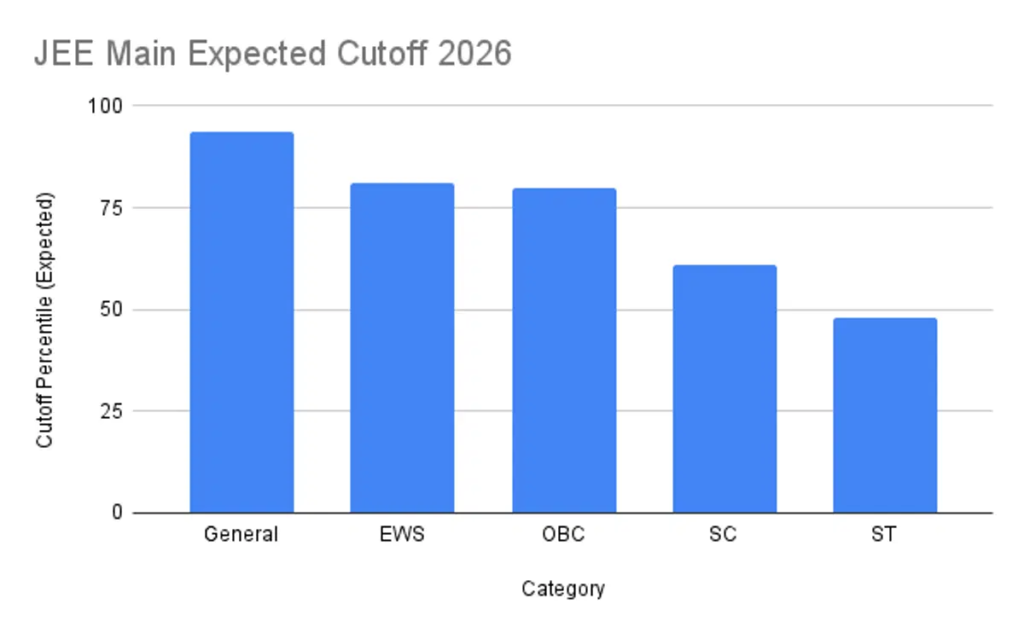
📈 Expected Passing Marks (Out of 300) – 2026 Trend
Based on previous year trends, difficulty level, and expert analysis:
🔹 General Category
- Expected marks: 90 – 100 out of 300
- Percentile: Around 85 – 90+
🔹 OBC / EWS Category
- Expected marks: 75 – 85
- Percentile: Around 70 – 80
🔹 SC Category
- Expected marks: 50 – 60
- Percentile: Around 45 – 55
🔹 ST Category
- Expected marks: 40 – 50
- Percentile: Around 40 – 50
👉 These are expected qualifying ranges, not official cutoffs.
🧠 Why JEE Main Cutoff Changes Every Year?
JEE Main cutoff is not fixed because it depends on multiple real-time factors:
📌 1. Difficulty Level of Exam
If the paper is tough, cutoff goes lower. If easy, cutoff increases.
📌 2. Number of Students
More students = higher competition = higher cutoff.
📌 3. Seat Availability
NITs, IIITs, and GFTIs have limited seats, which affects cutoff.
📌 4. Normalization Process
Since exam is held in multiple shifts, scores are normalized to ensure fairness.
⚖️ How JEE Main Ranking Works (Simple Explanation)
Your rank is not directly based on marks. Instead:
- Marks → Percentile → Rank → College
👉 Even if two students get same marks, their percentile may differ due to shift difficulty.
Recent reports also show that marks required for high percentile can vary significantly between shifts due to normalization effects.
🏫 What Rank You Need for Good Colleges?
Here’s a simple idea of what you can expect:
🔥 99+ Percentile
- Top NITs (Trichy, Warangal, Surathkal)
- CSE and top branches possible
⭐ 98–99 Percentile
- Mid to top NITs
- Good chance for CSE in lower NITs or ECE
⚡ 95–98 Percentile
- New NITs + IIITs
- Core branches like Mechanical, Civil
📉 Below 95 Percentile
- GFTIs and state colleges
🎯 What is a “Safe Score” in JEE Main 2026?
If your goal is:
👉 JEE Advanced qualification
- Safe score: 90–110+ marks (General category)
👉 Top NITs
- Safe score: 150–180+ marks
👉 Mid NITs / IIITs
- Safe score: 120–150 marks
👉 Just qualifying
- Around 75–100 marks (varies by category)
📉 Important Reality: Competition is Increasing
Every year, competition is getting tougher:
- More high scorers
- Higher cutoff for JEE Advanced
- Rising percentile requirement
In fact, recent trends show that qualifying cutoff for General category has crossed 93 percentile in some years, showing increasing competition pressure.
🧪 How to Use This Information Smartly
Instead of stressing, use this data wisely:
✔️ Step 1: Estimate your percentile
Use mock tests and previous papers.
✔️ Step 2: Predict your rank
Convert percentile into expected AIR.
✔️ Step 3: Shortlist colleges
- Dream colleges
- Safe colleges
- Backup options
✔️ Step 4: Prepare for counselling
Focus on JoSAA choice filling strategy.
⚠️ Common Mistakes Students Make
Avoid these errors:
❌ Thinking marks = rank
❌ Trusting fixed cutoff numbers
❌ Ignoring category benefits
❌ Not analyzing previous year trends
❌ Poor counselling planning
🚀 Final Words
JEE Main 2026 passing marks are not just a number—they are a combination of percentile, competition level, and exam difficulty.
👉 Key takeaway:
- 90–100 marks ≠ fixed passing guarantee
- Percentile is the real deciding factor
- Cutoff changes every year
So instead of focusing only on marks, focus on:
✔ Accuracy
✔ Mock tests
✔ Consistent revision
✔ Smart exam strategy